Signs You Need NFC and QR Review Products

If you serve people face to face and your review count is far below your customer count, that gap is the clearest sign you need physical NFC and QR products that open a configured review destination. The second sign is friction: if a happy customer has to search for your business, scroll past a map, and hunt for the review box, most will quietly give up. Work through the seven checks below and you will know in about ten minutes whether a tap card, tag, or stand solves a real problem in your business or not.
- The strongest sign is a wide gap between people served and reviews received - that is a capture problem, not a satisfaction problem.
- Time the journey on your own phone. More than about 15 seconds or any typing means friction is costing you reviews.
- If asking depends on staff remembering, a physical object on the counter does the asking instead.
- Match the sign to the format: stand for counters, card for mobile work, tag for small fixed surfaces.
- No subscription is required for the physical product, and nothing posts unless the customer chooses to write and submit the review.
1. Compare your monthly customers to your monthly reviews
Open your booking system, till report, or job sheets and count how many people you actually served in the last 90 days. Then count how many reviews arrived in that same window. If you served several hundred people and collected a handful of reviews, the issue is almost never that people disliked you - it is that nobody made it easy to say so.
There is no official benchmark here, so use your own judgement: a wide, obvious gap between volume served and feedback received is the sign. If the two numbers are already close, you may not need anything physical at all.
2. Time the path on your own phone
Hand your phone to someone who does not work for you and ask them to leave you a review from scratch. Count the taps, the scrolls, and every character they have to type. If the journey takes more than roughly 15 seconds, or if it requires typing your business name correctly, you have measurable friction.
Before you buy anything, grab a clean direct link with the google review link generator and retest. If the direct link fixes the journey on screen, a physical product simply puts that same link in front of people at the counter.
3. Check whether asking depends on someone remembering
Audit one normal week. If your review process is "the team mentions it at checkout," ask honestly how many shifts that actually happened on - during a rush, it is the first thing to drop. Staff turnover makes it worse, because every new hire has to be trained into the habit.
A physical prompt sits there every single shift and never forgets. If your process lives only in someone's memory, that is a sign.
4. Map the moments when customers are happy and holding a phone
Walk your space and list the places where a customer is both pleased and already reaching for their pocket: the counter at payment, the table after dessert, the reception desk at checkout, the chair after a cut, the doorstep as a job is signed off. Write down every one of them.
If you can name two or more of these moments, you have real places for a stand or card to live. If you genuinely have none - because all your work is remote or delivered online - physical products are not your answer.
5. Look at where your review link currently lives
If your only ask is an email or text sent hours or days later, you are asking after the good feeling has faded and after the customer has moved on to their evening. Check your send-to-open rate if you have one. Low engagement on follow-up messages is a sign that you are asking at the wrong moment, not with the wrong words.
6. Count your locations, vans, and front-line staff
One fixed counter is a different problem to six technicians in six vans. A single location can be solved with one visible item at the point of payment, while mobile teams need something each person carries and cannot forget at base.
If you have multiple people or vehicles meeting customers independently, you need a format that travels with each of them rather than one item on a desk somewhere.
7. Match the sign to the right format
Once you know which signs apply, the format choice is straightforward. Use this as a quick reference:
| Sign in your business | What it looks like day to day | Format that usually fits |
|---|---|---|
| Busy counter, very few reviews | High footfall, nobody is ever asked | Acrylic google review stand at the till |
| Staff forget to ask | Reviews arrive in bursts then stop | Stand on the counter plus cards for the team |
| Mobile or on-site work | Job finishes at the customer's home | A card each technician carries |
| No counter space to spare | Small desk, menu holder, window ledge | NFC tag with sticker on a fixed surface |
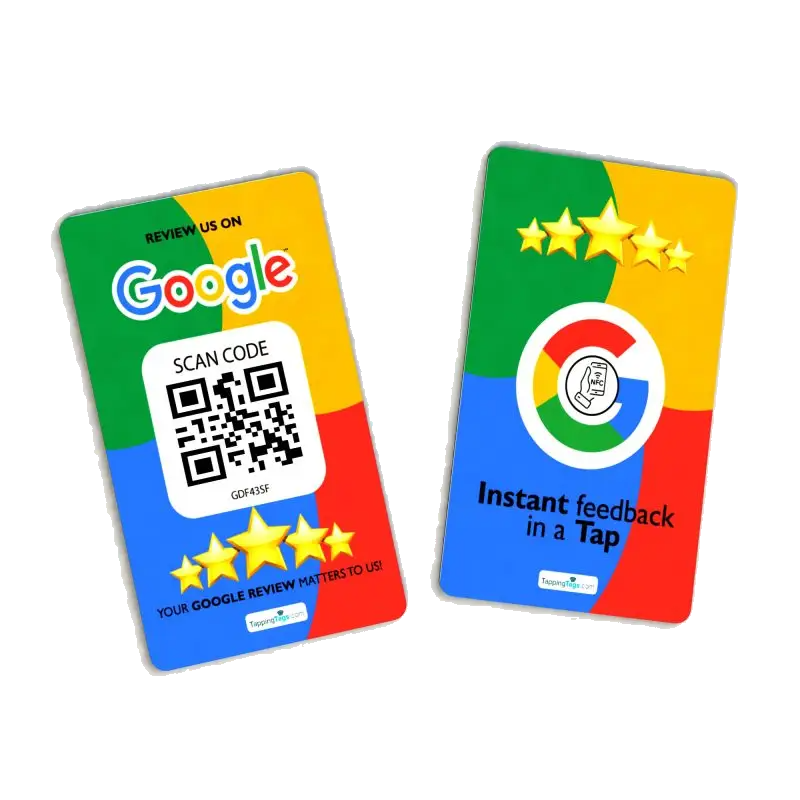
| Mixed older and newer phones | Some phones tap, some will not | Combined nfc google review card with a QR code |
A combined NFC and QR item is the safe default when you are unsure, because a customer who cannot tap can still scan.
Signs you probably do not need these yet
- You have no in-person contact with customers at any stage.
- Your review count is already in healthy proportion to your customer volume.
- You have not yet set up or confirmed the review destination the product should open.
- Your underlying service problem is unresolved - a faster review path will not fix that.
When to call a pro instead
If your review destination itself is wrong, duplicated, or unverified, sort that out before ordering anything physical. The same applies if you need a rollout across many sites with different destinations per location, or if you are unsure which profile a link should point to. In those cases, speak to someone who handles local listings rather than guessing - a perfectly good tap card pointed at the wrong destination still sends people nowhere useful.
Next step
If three or more of the checks above described your business, the fix is physical and simple. Start with the google review card range and pick the format that matches the moment where your customers are happiest. Nothing posts unless the customer writes and submits a review themselves, and no subscription is required for the physical product. For a related self-check, see Do You Need NFC and QR Review Tools? 7 Signs.
Frequently Asked Questions
No. Most modern phones open a tapped NFC item or a scanned QR code with the built-in camera or NFC reader, so the customer does not install anything. A combined NFC and QR item is the safest choice because anyone who cannot tap can still scan.
No. No subscription is required for the physical product. You configure the review destination it opens and the item keeps opening that destination.
No. The product only opens your configured review page. Nothing posts unless the customer chooses to write and submit the review themselves, so you never control what is said.
Three or more of the seven checks is a reasonable trigger. In particular, a wide gap between customers served and reviews received, combined with at least one in-person moment where customers are happy and holding a phone, means a physical prompt has somewhere real to work.
Choose a stand for a fixed counter or reception desk, a card for staff who meet customers away from your premises, and a tag with a sticker when you have a small fixed surface and no room for a stand. Many businesses use a stand plus cards together.